
In working closely with busy restaurant operators—especially those running high-volume Italian kitchens—I’ve seen just how challenging pasta production can be. Inconsistent cooking results, excessive heat in the kitchen, and rising energy bills are common issues that directly affect food quality, staff safety, and operational costs.
That’s why our client’s recent switch to induction pasta boilers has been truly transformative. These advanced units outperform traditional direct-electric pasta boilers in every key area: superior food consistency, energy savings exceeding 65%, rapid heat recovery, and significantly improved safety.
In this post, I’ll break down the real-world safety and cost advantages we observed during implementation, and explain why induction is quickly becoming the smart choice for any high-volume commercial kitchen.
The Drawbacks of Traditional Direct Electric Pasta Boilers
Direct electric pasta boilers, often rated at 12 kW, rely on analogue controls and manual basket dropping. Without a precise temperature setpoint, they boil water continuously – even during lulls – leading to overheating, slow recovery after adding cold pasta, and poor temperature control. This results in uneven cooking, mushy pasta, and increased risk of burns from steam or spills. In our chain, these issues meant more food waste, higher maintenance, and kitchens that ran hotter than necessary, straining HVAC systems and staff alike.
The Induction Edge: Quality, Efficiency, and Safety
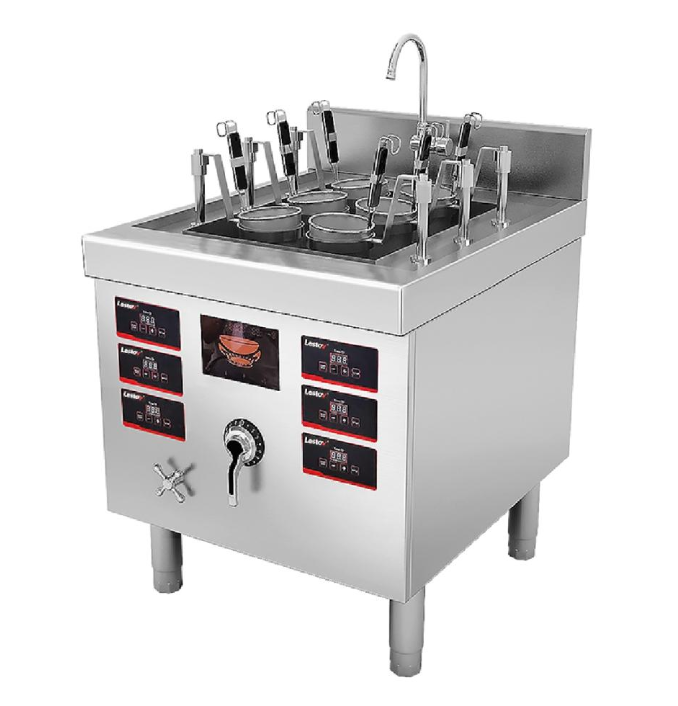
Induction pasta boilers, like our 15 kW models with one-shot rundown timers, use electromagnetic heating to target the water directly, offering game-changing advantages:
- Improved Food Quality: With even heat distribution and precise control, induction ensures consistent al dente pasta every batch. No more hotspots or overboiling – studies show induction provides uniform cooking, preserving nutrients and texture better than electric stoves.
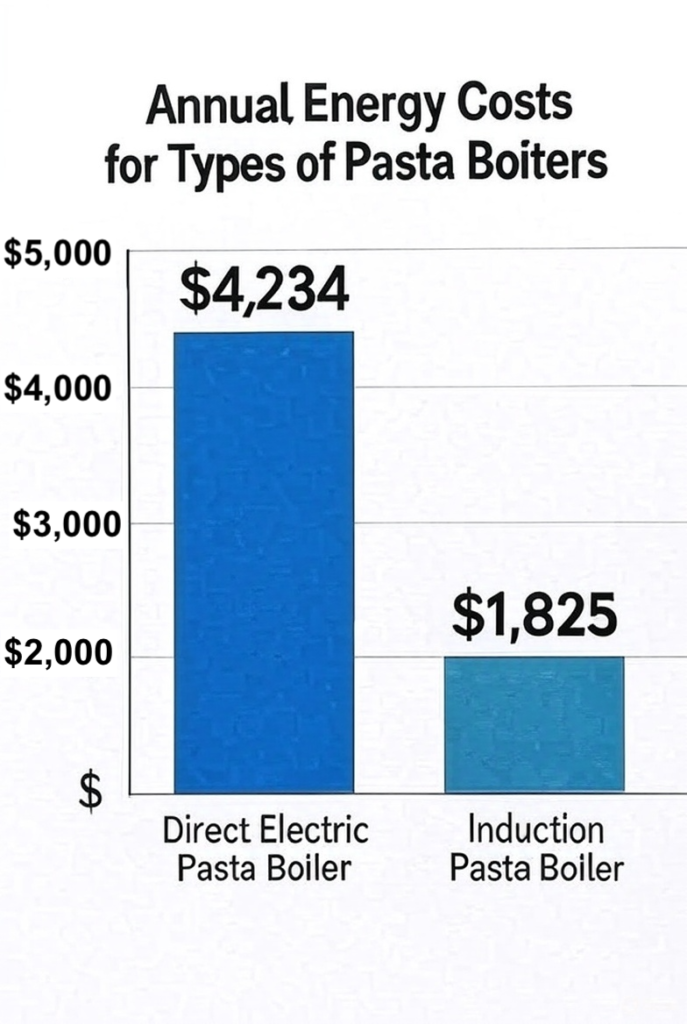
- Energy Savings and Fast Response: Induction saves over 65% in energy compared to direct electric units, thanks to rapid reheating (seconds vs. minutes) and features like auto-shutoff. Our one-shot timers activate heating only when pasta is needed, slashing idle consumption during quiet periods. General comparisons indicate 5-10% savings, but with automatic models, real-world gains hit 20-30% by avoiding constant operation. Reduced waste heat also cools kitchens, indirectly cutting HVAC costs.
- Enhanced Safety: No continuous boiling means lower burn risks and less steam buildup. Induction heats only when baskets are in place, making it safer for busy teams. Plus, cooler surfaces reduce accidental injuries.
To illustrate, here’s a picture of a commercial induction pasta boiler, showcasing its efficient design.
And for a visual on the efficiency, check out this comparison chart highlighting energy savings between induction and electric appliances.
Cost Analysis: Real Savings in Action
Let’s crunch the numbers for a typical 6-hour shift at $0.15/kWh:
- Direct Electric (12 kW, Continuous Boil): 12 kW × 6hours = 72kWh/day → $11.60/day.
- Induction (15 kW with Timers, On-Demand): Effective use at ~5 kW average (due to 65%+ savings and timers) × 6hours = 30 kWh/day → $5.00/day.
- Daily Savings: $6.60 (over 58%, scaling to 65%+ with optimizations).
- Annual Savings per Unit: $2,409 (R43,000).
With quick ROI and just over 12 months, lower maintenance, induction pays for itself fast. In our client’s chain, this upgrade has cut overall energy costs by over 50% in the pasta station alone.
If you’re battling inefficient pasta prep, induction boilers are a safer, smarter investment. They’ve elevated our dishes and operations – what’s your kitchen efficiency hack? Share below!