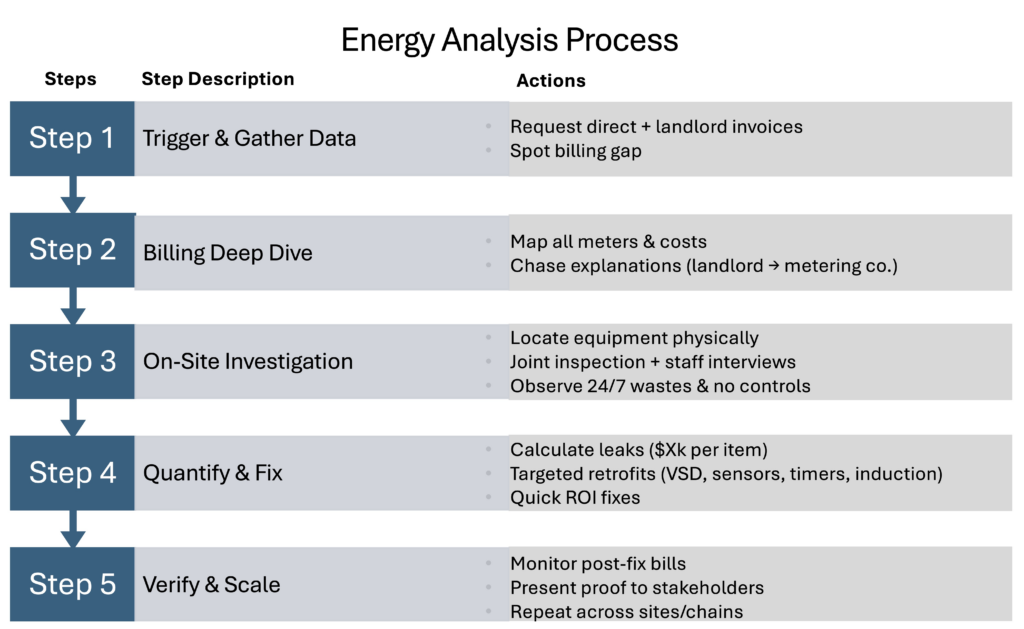
1. Initiate the Audit Triggered by a Discrepancy or Challenge (Preparation Phase)
- Steps:
- Define the issue, high bill or savings not achieved.
- Request comprehensive data: Utility bills (electricity, gas/LPG) and the landlord’s tenancy invoices.
- Review for anomalies: Look for total costs that don’t align.
2. Analyse Billing and Meter Data (Discovery Phase)
- Steps:
- Identify all meters: Note unique IDs, costs, and breakdowns.
- Cross-reference: Match direct utility bills against landlord charges to spot pass-through costs.
- Quantify wastes: Calculate annual extrapolations.
- If explanations are missing: Contact the landlord’s representative for details on what each meter supplies and its location.
- Escalate if needed: Refer to the metering/billing company for precise info.
3. Conduct On-Site Inspections and Verifications (Investigation Phase)
- Steps:
- Physically locate equipment: Search switchboards, utility cabinets, basements, and ceilings for meters and connected systems.
- Schedule joint inspections: Involve utility companies, landlords, or maintenance teams to verify each meter’s load.
- Assess inefficiencies: Observe during different shifts to note issues like no on/off controls, fixed speeds, or idling.
- Document findings: Note emotional reactions but focus on facts—quantify wastes.
- Interview staff: Talk to the General Manager or chefs about daily challenges.
4. Design and Implement Targeted Fixes (Resolution Phase)
- Steps:
- Prioritize high-impact areas
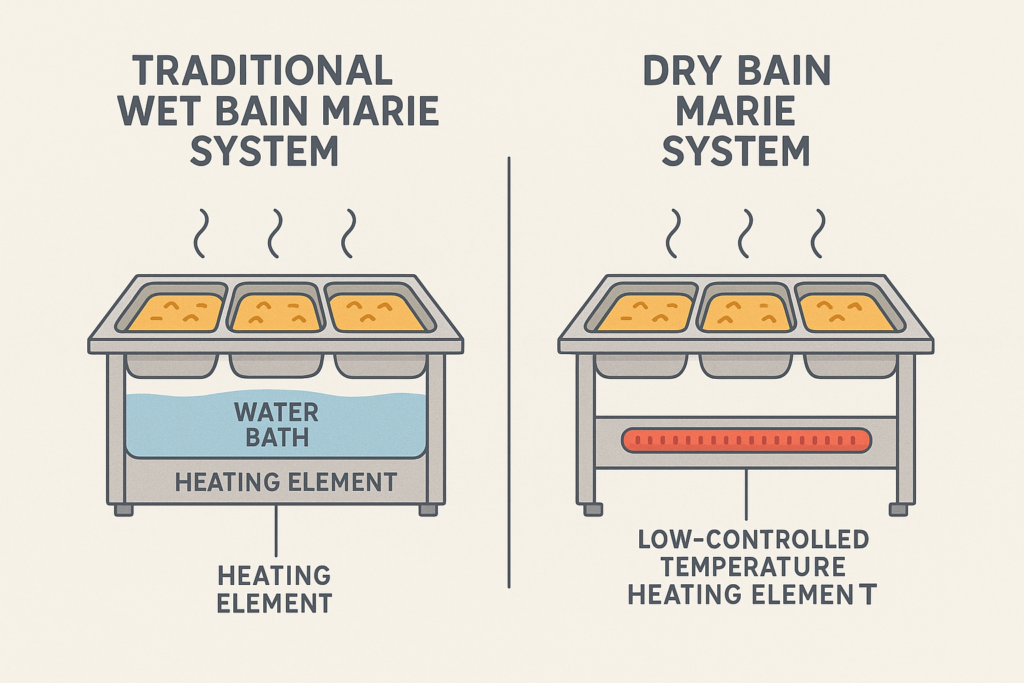
- Recommend retrofits over replacements.
- Calculate ROI: Ensure payback in under 3 years.
- Test and verify: Post-implementation, monitor bills for 1–3 months to confirm savings.
- Holistic view: Address interactions.
- Mindset Shift: View inefficiencies as opportunities—data-driven tweaks future-proof the business for sustainability and scalability.
5. Follow-Up and Scale (Sustainment Phase)
- Steps:
- Review with stakeholders: Present verified savings to the CFO/GM to rebuild trust.
- Document the blueprint: Create a shareable process for other sites.
- Scale: Recommend chain-wide audits.
- Overall Outcomes: From a disputed 20% to proven 50%+ savings, reclaiming margins without gut jobs.
This process is adaptable for any restaurant facing high energy bills from landlord setups. If this series is landing for you, what’s one energy leak you’re ready to plug right now? Drop your biggest win, worst woe, or DM me. I’m giving away my full energy audit blueprint to help you start your own turnaround.
#KitchenEnergySavings #EnergyEfficiency #HospitalityProfits