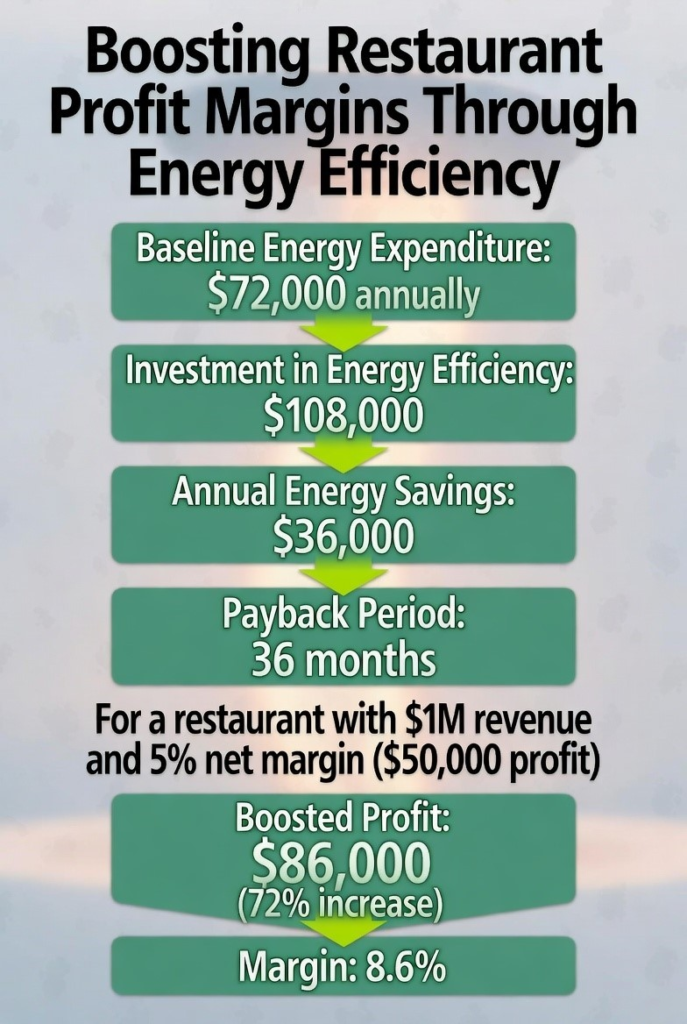
Yes, energy costs can be significantly reduced and impact your Restaurant’s profit margins. This blog lays out how energy cost savings can really elevate your thin profit margins. A busy restaurant can be spending $72,000 a year in electricity and gas costs. Electroproducts can show how to achieve annual energy savings of $36,000 on this type of bill, a whole 50%, with paybacks of 36 months or better, energy savings drop directly to the bottom line, the impact on profits can be profound. For our example restaurant with $1 million in revenue restaurant and a 5% net margin ( leaves a $50,000 profit margin), current energy costs by 50% could elevate profits to $86,000—a 72% increase—and pushes profit margins to 8.6%. In an industry where every percentage point counts, this could mean the difference between surviving and thriving, funding expansions, or weathering economic downturns.
In the fast-paced world of restaurant management, every dollar counts—and so does every kilowatt-hour. Imagine this: your kitchen hums along at full throttle for hours on end, hot passes blazing, bun toaster sizzling, salamander grilling, gas grills humming, stove hubs burning, deep fryer frying, oven preheated, extraction fan system sucking from the kitchen hood, and refrigeration units running non-stop. But here’s the stark reality—most restaurants generate 80% of their revenue during just 20% of their operating hours. Flip that script for energy consumption, and you uncover a hidden inefficiency: up to 80% of your energy use occurs during those slower lulls, when foot traffic trickles and orders dwindle, yielding only 20% of your revenue. Meanwhile, the high-energy bursts during peak rushes on a few days a week power the lion’s share of your profits.
At Electroproducts, we specialize in the supply of innovative and advanced energy efficient electrical and gas equipment, efficient all electric kitchens and specialised energy management solutions to automate energy saving that turn these imbalances into opportunities for real cost savings. In this post, we’ll dive into the data, unpack the “slow period paradox,” and share actionable strategies to optimize your energy footprint—without sacrificing the sizzle that keeps customers coming back.
The 80/20 Energy-Revenue Disconnect: What the Data Reveals
The Pareto Principle—better known as the 80/20 rule—has long guided business optimization, from inventory management to customer segmentation. In restaurants, it manifests dramatically in the mismatch between energy demands and revenue streams. Peak hours, often squeezed into lunch and dinner rushes on only a few days a week, such as Thursday, Friday, and Saturday, account for the bulk of sales but represent a fraction of your total operating time. Slow periods—early mornings, mid-afternoons, or late nights, particularly on Sunday, Monday, Tuesday, and Wednesday—stretch out, consuming vast amounts of standby energy with minimal return.
Consider the numbers: Restaurant kitchens are among the most energy-intensive commercial spaces, guzzling 2.5 to 7 times more energy per square foot (or meter) than typical office buildings. Take a typical 1,250 square foot (120 square meters) space. Annually, this translates to 24,000 kWh for an office compared to up to 360,000 kWh for a kitchen, with the myarid of cooking equipment, air conditioning and the extraction fan system as the primary culprits. During slow ticket times, these assets need idle inefficiently waiting and needing to be ready for customers: salamanders, hot passes and bun toasters radiate heat to maintain temperatures, grills burn away, bun toasters toast away, extraction hood fans keep sucking, and the dishwasher keeps the holding tank hot unnecessarily. The result? Electricity bills that balloon to 50% of total energy costs, often hitting $4,000 (R50,000) monthly for mid-sized venues.
This isn’t just theoretical—it’s a profit leak. If 80% of your energy spend fuels only 20% of revenue, you’re essentially subsidizing quiet hours at the expense of your bottom line. But with targeted interventions, restaurants can shave 30%-50% off total energy costs, redirecting those savings straight to growth initiatives like menu innovation or staff training.
Why Slow Periods Are the Low-Hanging Fruit for Efficiency
Slow periods amplify energy waste because equipment operates in a “maintenance mode.” Preheating for sporadic orders wastes heat, as kitchen staff wait for the next order to be placed. Existing equipment is not designed for these slow cooking periods, turning them into an energy money pit. Add in overlooked factors like significant heat loss from grills and griddles radiating heat due to slow pre-heating times, and the inefficiency compounds.
Our analysis at Electroproducts, drawn from partnering with hundreds of hospitality clients, shows that slow-period optimization yields the quickest ROI. Why? These windows can last over 60 hours a week, compared to just 24 hours of peak hours. Efficiency works because 80% of the time the restaurant kitchen is operating in slow ticket times. Peak-hour tweaks produce some energy cost savings; however, all equipment needs to run at full tilt to meet customer order demand.
Practical Strategies to Reclaim Your Energy (and Profits)
Ready to flip the 80/20 script? Here are six Electroproducts-backed tactics to target slow-period savings:
1. Smart Timers, Smart Controls, and Sensors: Deploy programmable timers on hot passes, salamanders, bun toasters, dishwashers, and griddles to sync with anticipated rushes. Install controls on extraction hood and supply air fans under a ventilation-on-demand strategy, taking away the power of staff to waste your hard-earned money. Our EnergyGuard Timer and Control Series automatically powers down during lulls, reducing standby losses by up to 65%.
2. Automate Power Downs: Utilities often charge premiums during system-wide peaks, but your slow periods align with standard rates. Our ConnectPro Energy Monitors track usage patterns, alerting you to shift non-essential loads (like dishwashers) to cheaper windows, potentially slashing demand charges by 20-25%.
3. Innovative Catering Equipment Upgrades: Key catering equipment such as hot passes, auto shutdown high performance gas grill, high performance gas fired pizza oven, induction stove hubs, induction deep fryers, induction flat plate griddles, induction pasta boilers and auto electric urn can be upgraded to save as much as 75% with world best practice technology.
4. Air Conditioning: Air conditioning is a heavy electricity user and is usually only installed as required, especially in varying climate conditions cities like Sydney, Melbourne, Johannesburg and Cape Town. where heating is required in winter and cooling in summer. Installation of our advanced smart thermostats, programmed to a fixed maximum temperature that is adjusted for seasonal climatic changes and automated off settings, can save 50% or more power.
5. LED Upgrades: Swap existing LED tubes and bulbs for our ProLED high-efficiency LEDs, which use 50% less power.
6. Data-Driven Energy Audits: Start with a baseline audit using our Nightjar 27-Channel electricity meter and our AuditPro Kit. Track internal data, from 1-minute to hourly consumption, which can be compared with sales data to pinpoint your 80/20 sweet spot—then layer in predictive analytics for proactive adjustments.
Implementing this baseline and restaurant kitchen energy use profiling is about precision. One client, a bustling chic casual chain, reduced slow-period energy by 60% in the first quarter, boosting net margins by 4% without a single menu tweak.
The Bigger Picture: Sustainable Success in Hospitality
Energy efficiency isn’t just a cost-cutter—it’s a competitive edge. The innovative catering products produce superior quality cooked food due to more precise and stable temperature controls on grills, griddles and deep fryers, as well a reducing the restaurants’ greenhouse gas emissions. In an era of rising utility rates and eco-conscious diners, restaurants that master slow-period optimization stand out. Lower bills mean more reinvestment in experiences that drive loyalty, from farm-to-table sourcing to seamless tech integrations.
At Electroproducts, we’re committed to powering your success, sustainably. Explore our full suite of restaurant solutions or schedule a free energy assessment today. What’s your biggest slow-period challenge? Drop a comment below—we’d love to hear and help.
Ready to unlock your savings? Contact us at info@electroproducts.co.za or visit electroproducts.com/restaurant-efficiency for tailored recommendations.