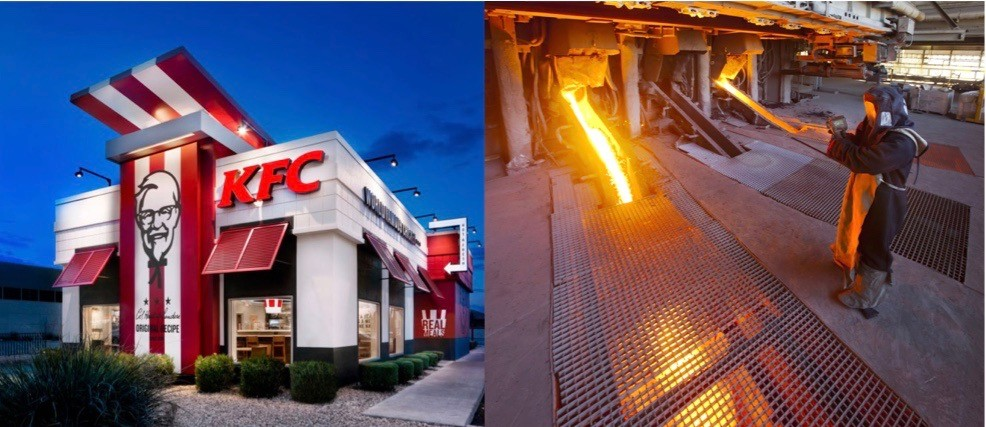
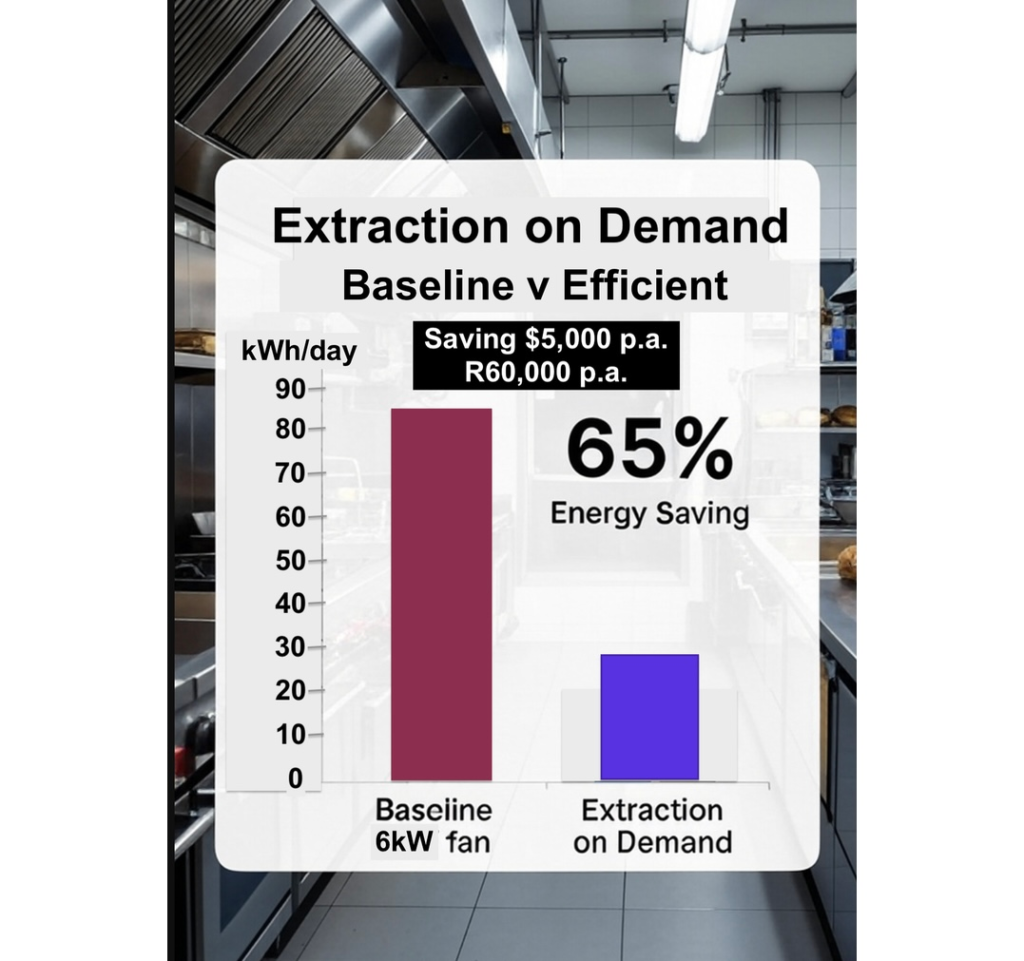
Restaurant chain owners can now access world best energy management technology affordably, I’m excited to share how we’ve cut one high energy use kitchen guzzler by up to 65% with “Extraction on Demand” – a sensor-driven system that smartly controls ventilation fans.
It’s a game-changer we’ve implemented across many locations for cost conscious clients its called “Extraction on Demand” – a smart ventilation system that uses sensors to dynamically control extraction and supply fans in the kitchen. Not only does it maintain a clean, fresh environment, but it also delivers massive energy savings, up to 65% on fan-related electricity costs. In this post, I’ll break down the technical details, including how it leverages the Affinity Laws (often referred to as the “fan laws”), complete with diagrams and real-world calculations.
The Problem with Traditional Kitchen Ventilation
In a typical restaurant kitchen, extraction fans run at full speed throughout operating hours to handle smoke, humidity, and odors. This constant high-power operation is inefficient, especially during quieter periods when full extraction isn’t needed. Our kitchens operate 14 hours a day, but peak extraction events – like during heavy frying or grilling – only total about 60 minutes. Running fans at max all day wastes energy and drives up bills, with electricity costs ranging from 15 to 25 cents per kWh.
Introducing Extraction on Demand
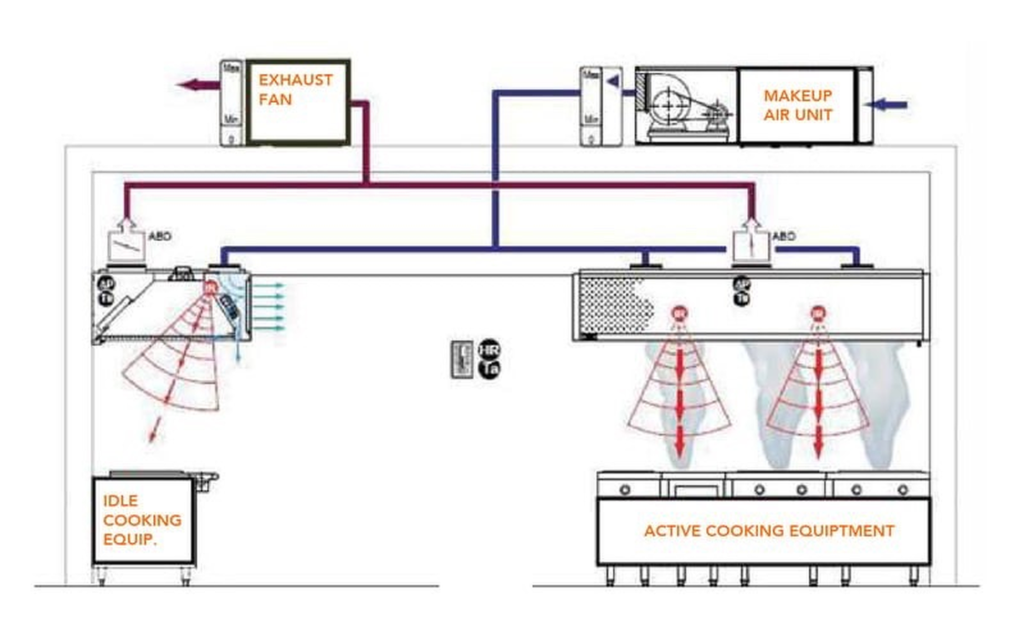
The system uses smoke and humidity sensors strategically placed in the kitchen hoods and ducts. Here’s how it works:
– Idle Mode: Fans default to a lower speed (40 Hz via variable frequency drives, or VFDs) to provide sufficient fresh air circulation and maintain air quality.
– Trigger Event: When sensors detect elevated smoke or humidity levels (e.g., above predefined thresholds), the system ramps up to full speed (50 Hz) for both the extraction fan (pulling out contaminated air) and the supply fan (bringing in fresh air to balance pressure).
– Reset: Once levels normalize, the fans automatically drop back to idle speed. Typically after 30 seconds.
This on-demand approach ensures the kitchen stays clean and safe while minimizing unnecessary power use. Below is a diagram illustrating a typical commercial kitchen ventilation setup with sensor integration.
The Science Behind the Savings: Affinity Laws
The magic lies in the Affinity Laws, which govern fan performance. These laws state that the power drawn by a fan motor is a cubic function of its speed: Power ∝ Speed Cubed.
In simple terms:
- If you reduce fan speed by 20% (from 50 Hz to 40 Hz, a ratio of 0.8), power consumption drops to 0.8³ = 0.512, or about 51% of full power. That’s a powerful formula if understood.
- For our fans, full-speed power ranges from 3 kW to 8 kW (depending on kitchen size and setup), but at idle, it’s significantly lower due to this cubic relationship, down over 65%.
Here’s a graph demonstrating the Affinity Laws, highlighting how power (the yellow line) rises cubically with speed, while flow and pressure scale linearly and quadratically, respectively.
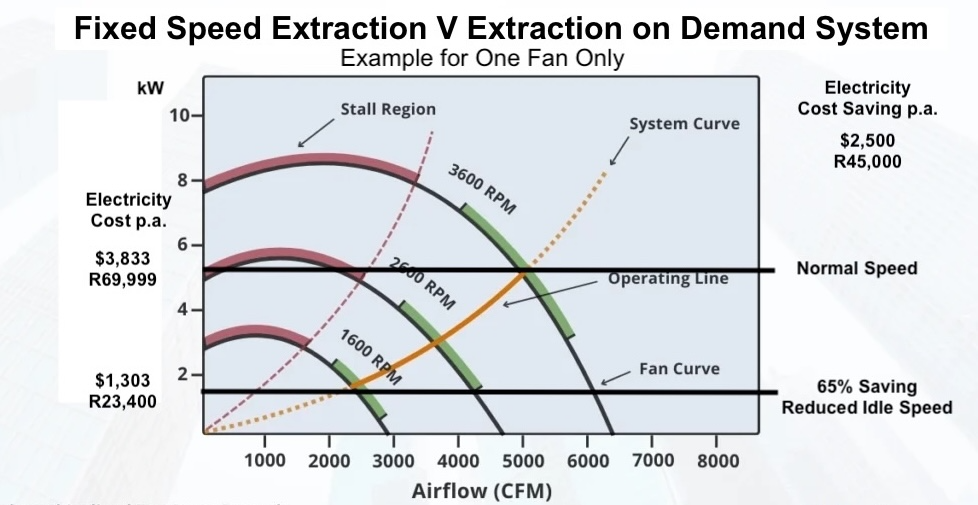
This non-linear relationship means small speed reductions yield big power savings – perfect for idle modes.
Crunching the Numbers: Achieving 65% Cost Reduction
Let’s model a typical day with combined extraction and supply fan power at full speed (50 Hz) averaging 8 kW, dropping to around 3 kW at idle (40 Hz, per the cubic law approximation).
– Traditional System (Always Full Speed): 8 kW × 14 hours = 112 kWh/day.
– On-Demand System: Full speed for 1 hour (8 kW × 1 = 8 kWh) + Idle for 13 hours (3 kW × 13 = 39 kWh) = 47 kWh/day.
– Daily Energy Savings: 112 – 47 = 65 kWh (approximately 58% reduction, scaling up to 65% in optimized setups with variable loads).
At 15-25 cents/kWh:
– Daily cost savings: $9.75 to $16.25.
– Annual savings (365 days): $3,560 to $5,930 per kitchen.
For larger chains, this adds up quickly – we’ve seen six-figure savings across our portfolio. Plus, reduced wear on fans extends equipment life.
Why It Matters for Restaurant Owners
Beyond costs, this system improves staff comfort with consistent fresh air and complies with health codes by preventing buildup of contaminants. Implementation is straightforward: Retrofit VFDs and sensors cost far less than the savings recoup.
If you’re running a restaurant chain, consider auditing your ventilation. Extraction on Demand isn’t just efficient – it’s a smart investment in sustainability and profitability. What efficiencies have you found in your operations? Share in the comments!