Drive up to a 72% boost in a restaurant profits just from energy cost savings. When store-wide energy efficiency solutions are implemented a restaurant can save 50% of its energy bills. This has been proven time and gain.
Since these savings drop directly to the bottom line, the impact on restaurant profits are profound. For our example restaurant with $1 million in revenue and a 10% net margin ($100,000 profit), reducing annual energy costs by $36,000 and elevating profits to $136,000—a 36% increase—and pushes margins to 13.6%. In an industry where every percentage point counts, this could mean the difference between surviving and thriving, funding expansions, or weathering economic downturns.
In the high-stakes arena of commercial kitchen operations, productivity isn’t just about qualify food at speed—it’s about precision, where every watt and every workflow contributes to the bottom line. Envision your commercial kitchen in motion: gas grills and pizza ovens preheating, deep fryers firing up for lunch rushes, extraction fans whirring constantly, refrigeration units humming 24/7, and dishwashers cycling through loads. Yet, hidden beneath this bustle are productivity pitfalls—equipment idling during slow hours, energy spikes from inefficient appliances, and mismatched workflows that drain resources without delivering output. The reality? Many kitchens operate at suboptimal productivity, with energy consumption often outpacing actual order fulfilment by a wide margin.
At Electroproducts, we draw on extensive experience supplying advanced energy-efficient electrical and gas equipment, including super efficient all-electric kitchen solutions, and specialized smart metering systems to transform these insights into actionable gains. In this post, we’ll break down Smart Metering 101, explain how it can measure and elevate kitchen productivity, and offer proven strategies to integrate it seamlessly—ensuring your operations run leaner, smarter, and more profitably without compromising culinary excellence.
Smart Metering Demystified: The Foundation of Kitchen Productivity
Smart metering goes beyond basic utility tracking; Electroproducts uses a 27 channel; a sophisticated system that monitors energy usage in real-time across 9 x three phase or a number of individual circuits; mains, kitchen equipment, and air conditioning. By capturing granular data—like kilowatt-hours per hour on a deep fryer or cold room—it reveals how energy correlates with productivity metrics such as high ticket times, and staff output.
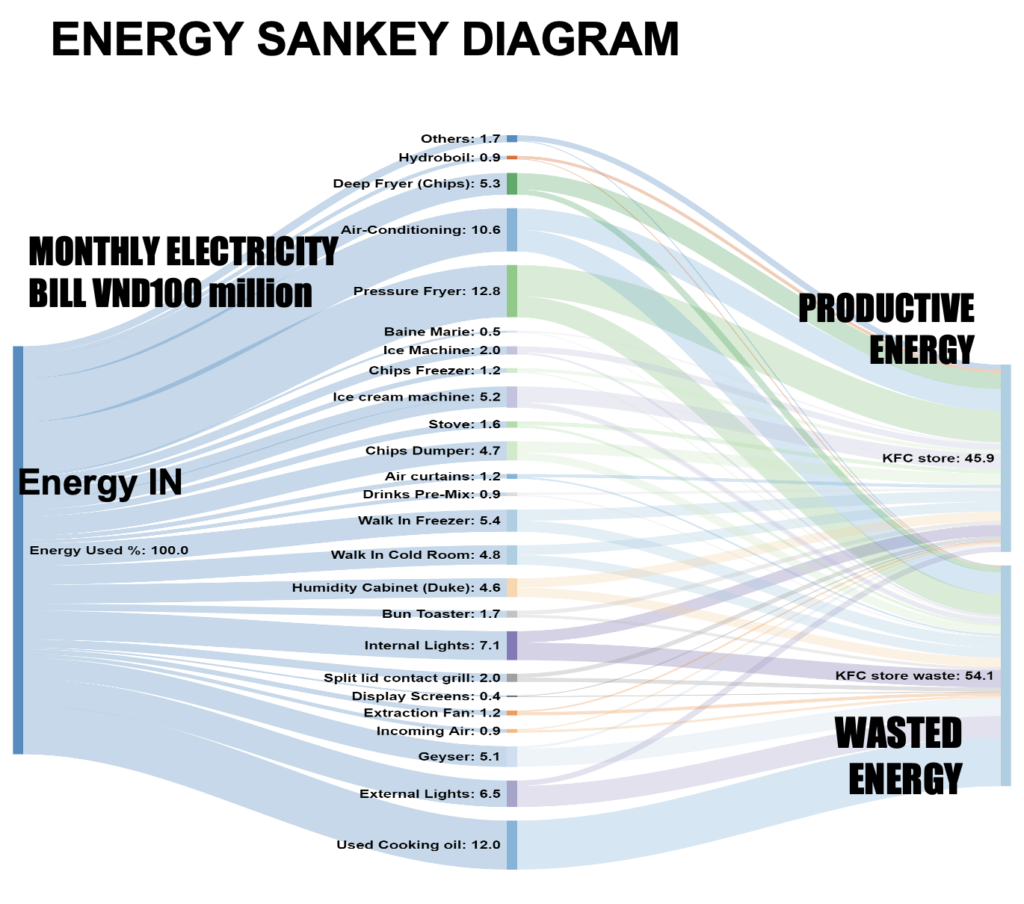
In commercial kitchens, where energy can account for 4-7% of total costs, smart meters act as a diagnostic forensic tool, highlighting energy use by equipment can identify inefficiencies that erodes productivity. Crucially, this data enables the construction of a restaurant-specific Sankey diagram, visualizing energy flows by equipment to map productive uses (e.g., during high-output cooking) versus energy waste (e.g., standby losses in idle periods), providing a clear picture of where resources are truly adding value. In the Sankey diagram below, we identify that only 46% of the restaurant’s energy was being used productively and 54% being wasted. We included electricity and cooking oil together in this analysis as cooking oil is an energy resource that can be exploited. This restaurant did not have any gas equipment.
What is an Energy Flow Diagram & How to Create it?
A Sankey diagram maps on the left hand side the Energy Input to the store and maps where all the energy in consumed in the centre part of the diagram. On the right hand side of this Sankey diagram each equipment’s energy use if further divided into Productive Energy and Wasted Energy. Productive Energy is defined as energy that produces cooke food in response to food order tickets received. Wasted Energy is defined as energy consumed that does not produce ticket cooked food for customers. Here of 100% of the energy supplied, 54% is wasted and 45% is productive. Now the question is what is the expenditure for the energy input, and is there a business case to reduce the energy waste.
The Data Reveals: Energy as a Proxy for Productivity
From our work with hundreds of hospitality sites, we’ve seen consistent patterns: Kitchens consume 3-5 times more energy than comparable commercial spaces, with peaks tied to high-ticket periods (e.g., Thursday-Saturday lunches and dinners) and wasteful low ticket times troughs during low-output periods (Sunday-Wednesday mornings and later evenings). Using smart meters, we correlate energy data with POS sales: For instance, a larger-sized kitchen might burn 300,000 kWh annually, but analysis shows 80% of that occurs during times yielding only 20% of revenue—indicating low productivity zones where equipment runs hot but ticket orders low.
By establishing an online 27 Channel 1-minute interval electricity data, we gain detailed insights into energy use over each day of the week, informing precise solution design business cases. This high-resolution data, when combined with our AuditPro Kit, allows us to build a powerful business case by establishing a reliable baseline for current usage and verifying post-implementation energy savings through before-and-after comparisons.
Consider a typical setup: A 1,500 square foot (150 square meter) kitchen logs $5,000-$6,000 monthly in energy bills (electricity and gas combined). Smart metering pinpoints culprits like extraction fans running during idle times or ovens maintaining heat unnecessarily, reducing overall productivity by 65%-75%. This isn’t mere waste—it’s untapped potential. By quantifying these gaps with integrity, we can create a business case for a restaurant that’s reliable for informed decisions, turning data into decisions that enhance workflow efficiency and staff allocation.
Why Smart Metering is Essential for Measuring and Boosting Productivity
Productivity and quality outcomes in commercial kitchens hinges on several factors;
- the reliability and consistency of the equipment
- the time it takes for catering equipment to go from cold to full operating temperature
- the time it takes for catering equipmen to attain full operating temperature from a warm condition (idle condition)
- the accuracy of setting the target temperatures on catering equipment
- the temperature recovery time from product loading
- the energy input needed to idle the equipment
Energy efficiency can be expressed as the amount of energy input needed to yield product output at the target temperature. Without metering, inefficiencies hide in plain sight—inefficient appliances during peaks lead to reductions in quality, while underutilized ones in slow periods inflate energy costs. Smart metering flips this by providing real-time visibility, enabling predictive facts to forecast energy cost savings from upgrading the equipment or optimizing the appliance sequencing during its operating lifecycle. It all revolves around building a business case with high integrity. Using metered data to establish operational baselines, and used to verify savings, and design solutions that deliver measurable ROI.
Our Electroproducts insights show ROIs as quick as 6-12 months in some instances and typically under 36 months, metering uncovers current wasteful practices examples include dishwasher wasting 50%, an electric flat plate wasting 60%. Energy efficient catering equipment addresses not just energy waste, but also improves cooking outcomes as the equipment provides faster response times to heat up and more stable cooking temperatures, which means cooking times are reduced. On more than several occasions we reduced extraction air energy by 85% through the revelation that a centre management Landlord is operating a roof mounted extraction fan 24 hours a day. Energy savings in Air Conditioning often reveals particularly powerful data in changeable temperate or subtropical climates with pronounced intra-day weather shifts and maritime or elevational moderation like Sydney, Brisbane, Melbourne, Johannesburg, or Cape Town, where HVAC waste is promient if not controlled precisely.
Practical Strategies to Implement Smart Metering for Peak Productivity
Ready to meter your way to higher productivity? Here are five Electroproducts-endorsed tactics:
- Establishing the Restaurant Baseline Auditing with Sankey Visualization: Begin with our Nightjar 27-Channel electricity meter to log multi-circuit data at 1-minute intervals. Pair it with our AuditPro Kit to overlay energy profiles of the large energy hogs in the kitchen against sales data, then generate a Sankey diagram to map equipment-specific flows—distinguishing productive energy (e.g., active grilling) from waste (e.g., heat radiation in lulls)—and build a solid baseline for your business case.
- Real-Time Monitoring and Alerts: Deploy our ConnectPro Energy Monitors for live dashboards that flag anomalies—e.g., a spike in dishwasher energy during off-hours—allowing instant tweaks to boost workflow efficiency and reduce downtime, with data verification ensuring savings claims hold up.
- Appliance-Specific Upgrades: Integrate metering with efficient upgrades, such as induction deep fryers or auto-shutdown gas grills, which cut energy by up to 50% while maintaining output. Metering validates the productivity lift through weekly patterns, strengthening your decision-making business case.
- Predictive Analytics Integration: Use metered 1-minute data to forecast high ticket periods and automate controls, like ventilation-on-demand for extraction systems or smart thermostats for air conditioning, saving 65% on power while synchronizing and verifying results against baselines.
- Staff Training and Dashboards: Equip teams with user-friendly apps tied to metering systems, empowering them to monitor their zones and adjust habits—turning data into daily productivity habits that minimize waste, all backed by a reliable business case for sustained improvements.
One client, a high-volume fast-casual outlet, implemented our metering suite—complete with Sankey diagrams and 1-minute interval analysis—and we were able to identify a plan to save 35% of energy costs in the first quarter and net margins up 3.5%—all from data-driven optimizations verified through baselines, no operational overhauls needed.
The Bigger Picture: Data-Driven Sustainability and Success
Smart metering isn’t just about measurement—it’s a gateway to allow all smart equipment to connect to and provide online access. By linking energy to output via tools like Sankey diagrams, baseline establishment, saving verifications, and 1-minute data insights combined with our AuditPro Kit, reliable business cases can be produced. The business case provides the recommended energy efficiency equipment and energy management interventions, per item annual energy cost savings, per item and total investment requirement and per item and total payback in months. And CO2 emission reductions, this information can appeal to green-minded patrons, and the recommended initiatives will build operational agility amid rising costs. Ultimately, it’s about crafting a business case with integrity and reliability to guide strategic decisions, ensuring long-term success in hospitality where margins are razor-thin.
At Electroproducts, we’re passionate about equipping kitchens with tools for sustainable productivity. Browse our smart metering solutions or book a consultation today. What’s your top productivity challenge in the kitchen? Share below—we’re eager to assist.
Ready to measure and maximize? Email admin@electroproducts.com.au or head to electroproducts.com.au/restaurant-efficiency for customized advice.